

COLOMBO — By 2070, the religious landscape of the planet will look fundamentally different—not because of mass conversions, but because of the quiet, relentless mathematics of human demographics.
According to a comprehensive 50-year projection by the Pew Research Center, drawing on census and survey data from 201 countries and territories covering nearly 100% of the world’s population, Islam is projected to overtake Christianity as the world’s largest religious group by 2035. By 2070, Muslims are expected to account for 36% of the global population (3.64 billion people), up from 26% (2.02 billion) in 2020, while the global Christian population is projected to plateau just under three billion.
While the headline shift is global, the epicenter of this transformation lies in two regions: South Asia, where demographic momentum is reshaping the subcontinent, and Sub-Saharan Africa, which is rapidly becoming the new heartland of global Christianity.
South Asia at the Center of Global Change
Nowhere are demographic projections more closely watched—or more politically sensitive—than in India. The Pew study confirms that while India’s religious composition will shift gradually over the next five decades, the nation will remain overwhelmingly Hindu.
Between 2020 and 2070, India’s Hindu population is projected to grow by 176 million, even as its share of the total population dips slightly from 79% to 76%. Over the same period, India’s Muslim population is projected to rise from 15% to 20%, reaching approximately 334 million—making India home to the second-largest Muslim population in the world.
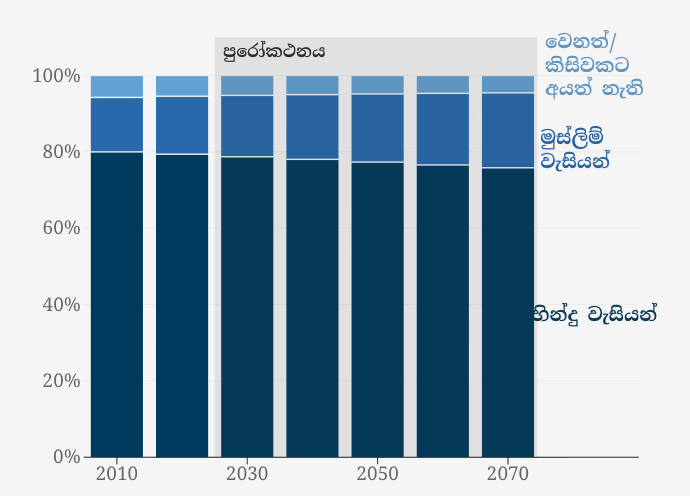
Source: Pew Research Center.
Note: Figures for 2010 and 2020 are estimates based on census and survey data; figures for subsequent years are projections. The “Other/Unaffiliated” category includes Buddhists, Christians, Jews, followers of other religions, and the religiously unaffiliated.
Across the broader region, the shift is equally striking:
- Pakistan is projected to more than double its Muslim population to 461 million by 2070, overtaking Indonesia to become the world’s most populous Muslim-majority nation.
- Bangladesh’s Muslim population is projected to climb to 218 million.
- India and Nepal will remain the only two Hindu-majority countries in the world.
Demographic Momentum vs. Political Myths
In India, projections of a growing Muslim share have frequently been seized upon by right-wing groups to claim that Hindus could eventually become a minority. Demographers analyzing the Pew data firmly reject these alarmist narratives, noting there is no evidence of large-scale religious conversion driving these numbers.
Instead, the shift is explained by two foundational concepts in population science: age structure and replacement-level fertility (the benchmark of roughly 2.1 children per woman required for a population to replace itself without migration).
- A Younger Population Base: In 2020, the median age of Indian Muslims was 24, compared to 29 for Indian Hindus. Because a larger share of the Muslim population is entering or currently in their childbearing years, the community experiences greater demographic momentum—meaning its population continues to grow even as individual families have fewer children.
- Narrowing Fertility Gaps: Between 2025 and 2030, Indian Muslim women are projected to have an average of 2.3 children, compared to 1.8 for Hindu women. While Hindu fertility has already fallen below the replacement level of 2.1, Muslim fertility is expected to remain above it for another two decades.
“We expect changes in India’s religious composition to be driven almost entirely by long-standing demographic differences between Hindus and Muslims,” Stephanie Kramer of the Pew Research Center told the BBC. However, she emphasized that the fertility gap has shrunk dramatically—from more than one child per woman in 1992 to roughly half a child today—and is expected to narrow further.
K. S. James, an Indian demographer at Princeton University, echoed this assessment, noting that fertility is falling across all religious communities in India. “Eventually, they will converge,” he said, stressing that the projections do not represent a dramatic departure from India’s established demographic path.
The Great Realignment: Global Shifts by 2070
Beyond South Asia, the Pew study highlights profound geographical realignments across every major faith tradition:
| Religious Group | Key Projected Shift by 2070 | Primary Demographic Driver |
| Muslims | Largest global group by 2035; 36% of world population (3.64B) by 2070. | Youngest median age globally and highest average fertility rates. |
| Christians | Remains just under 3 billion; over 50% will live in Sub-Saharan Africa (up from 31% in 2020). | High birth rates in Africa; rapid secularization and aging in Europe and the US. |
| Religiously Unaffiliated | Majority in the UK, France, and South Korea; largest group in Australia. Global share drops from 24% to 17%. | Rising secularism in the West offset by steep population decline in China (home to two-thirds of the global unaffiliated). |
| Buddhists | Steepest demographic contraction; populations in China, Japan, and South Korea to drop by more than half. | Severe aging and ultra-low fertility (“demographic winter”) across East Asia. |
| Hindus | Remains concentrated in South Asia; the US becomes the 5th-largest Hindu nation globally. | Sustained growth in India paired with high-skilled international migration to the West. |
Christianity Moves South, Secularism Moves West
For centuries, Europe and the Americas defined the demographic center of Christianity. By 2070, that era will have decisively ended. Europe’s share of the global Christian population is projected to halve from 22% to 11%. Meanwhile, the Democratic Republic of the Congo is projected to overtake the United States as the country with the largest Christian population on Earth. In the US itself, Christians are projected to lose their majority status by 2065, though they will remain the largest single group.
Buddhism’s Demographic Winter
While Islam and African Christianity expand, Buddhism faces an acute demographic squeeze. Concentrated heavily in East Asia—a region grappling with the world’s lowest birth rates and fastest-aging societies—the Buddhist populations of China, Japan, and South Korea are projected to shrink by over 50%. Even in Southeast and Central Asia, countries such as Laos and Mongolia are projected to lose their Buddhist majorities by 2070.
The Caveats: Projections Are Not Prophecies
Demographers are careful to distinguish between projections and predictions. The Pew study models what will happen if current trends in fertility, mortality, migration, and religious switching continue uninterrupted.
As the report explicitly notes, its models cannot account for “black swan” events—such as major wars, pandemics, climate-driven displacement, or sudden economic and cultural upheavals—that can radically alter birth rates or migration flows within a single generation. Furthermore, because India’s decennial census has been delayed, the study’s 2020 baseline for India had to be estimated using data from the 2011 census.
Even with those caveats, the overarching trajectory is unmistakable. Over the next half-century, the global map of faith will be redrawn not in pulpits or parliaments, but in maternity wards, aging cities, and migration corridors—cementing South Asia and Sub-Saharan Africa as the twin demographic engines of the 21st century.


