

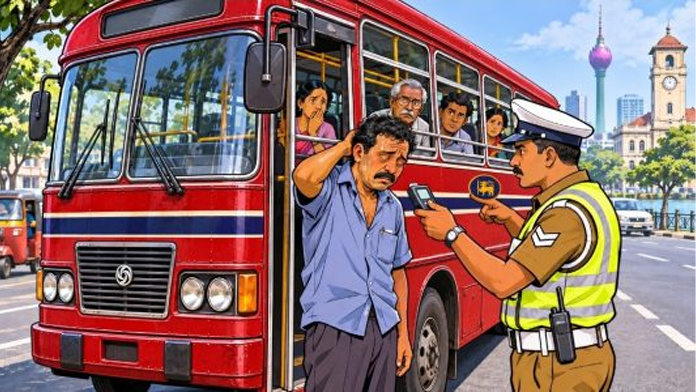
COLOMBO — When Hulftsdorp Magistrate’s Court No. 07 stripped a 58-year-old Sri Lanka Transport Board (SLTB) bus driver of his driving licence for life on Thursday (November 19), many commuters welcomed the ruling as a rare moment of decisive accountability on the country’s perilous roads.
The driver, a resident of Narammala operating a Route 05 bus from Colombo to Kurunegala, had ignored traffic officers attached to the Maradana Police Station who attempted to halt the vehicle for an inspection along Sangharaja Mawatha. Officers were forced to pursue and intercept the bus, subsequently confirming through examinations that the driver was operating the passenger-filled vehicle under the influence of alcohol. Alongside the lifetime licence cancellation, the court imposed a fine of Rs. 35,000, according to a statement from the Police Media Division.
While the swift judicial penalty made headlines, it also cast a harsh spotlight on a far deadlier, systemic reality that Sri Lankan commuters endure every day: the unchecked culture of reckless driving, alcohol abuse, and narcotic use—most visibly entrenched within the country’s powerful private bus sector.
A Road Safety Crisis Fuelled by Drugs and Alcohol
The Hulftsdorp ruling is an isolated victory in a losing battle. Across Sri Lanka, public transport has increasingly become a roulette wheel for daily passengers.
Recent enforcement drives have revealed the alarming scale of substance abuse behind the wheel. Throughout 2026, mobile laboratory inspections conducted by the National Transport Medical Institute and the Ministry of Transport have repeatedly detected bus drivers and conductors operating under the influence of dangerous narcotics. By August, expanded roadside testing across several provinces found that nearly 10% of screened bus staff tested positive for drug use.
In the private bus sector, this substance abuse is directly tied to an exploitative, unregulated operating model:
- Commission-Based Racing: Unlike salaried transit workers in developed systems, most private bus crews are pressured to meet steep daily revenue targets. Drivers routinely speed, overtake blindly, and cut across lanes to beat rival buses to the next halt.
- Grueling Shifts: To endure exhausting, back-to-back long-distance and urban shifts without adequate rest, a growing number of drivers and conductors turn to illicit stimulants, narcotics, and alcohol.
- Zero Accountability: Even when drivers are caught in sporadic police raids, the underlying system remains untouched. A suspended driver is simply replaced by another operating under the exact same reckless incentives.
The Anatomy of the Private Bus Mafia
To understand why Sri Lanka’s roads remain lawless, one must look beyond the drivers to the entrenched syndicates that control the industry. For decades, commuters and analysts have referred to the network of private bus owners and powerful associations as the “private bus mafia.”
Operating as an informal cartel, these associations wield immense leverage over the country’s daily mobility. Whenever authorities attempt to enforce strict road discipline, introduce modern alternatives, or resist demands for fare hikes, private operators routinely threaten islandwide strikes—effectively holding millions of working-class commuters hostage.
Even recent efforts to modernize urban transit have met with aggressive pushback. Following the introduction of state-backed Metro buses in Colombo, private bus operators have been accused of intimidating crews and physically blocking Metro buses from parking at key hubs such as Kollupitiya.
Why Successive Governments—Including This One—Blink First
For over three decades, successive Sri Lankan governments have promised a “sustainable solution” to the public transport crisis. Proposals for unified timetables, GPS-tracked route management, cashless ticketing, and mandatory drug screening have been announced with fanfare, only to quietly collapse under pressure.
Critics argue that the current administration is now falling into the exact same trap of “bus politics.” Despite coming to power with a strong mandate to dismantle entrenched cartels and reform public services, the government has shown a noticeable reluctance to confront the private bus mafia head-on.
The hesitation is rooted in political pragmatism—and fear:
- Fear of Immediate Paralysis: Because the state-run SLTB lacks the fleet capacity to absorb the country’s daily commuter demand on its own, a coordinated private bus strike can bring the economy to a grinding halt within hours.
- Electoral and Union Leverage: Private bus owners and associations represent a vocal, well-organized lobby with deep roots in local politics. Direct confrontation risks sustained public friction and orchestrated disruptions.
- Symptom-Treating Over Structural Reform: Rather than revoking route permits of repeat offenders or dismantling the daily-target commission model, authorities have largely relied on temporary police crackdowns, warnings of legal action, and sporadic mobile lab raids.
The Cost Paid by Commuters
A lifetime driving ban handed down by a Magistrate’s Court sends a strong message to an individual offender. However, courtrooms cannot fix a broken transport policy.
As long as the state remains fearful of confronting the private bus mafia and dismantling the political shield that protects it, isolated arrests will do little to change the reality on Sri Lanka’s highways. Until a government is willing to absorb the short-term political cost of a true structural overhaul, ordinary Sri Lankans will continue to board their daily buses knowing that their safety is secondary to the politics of the road.
Feature Image Source – www.newswire.lk


